What financially smart Americans are doing instead

I want to talk about something that doesn't come up enough in polite conversation.
Most of us have been quietly doing the math on Social Security — and quietly not liking what we find.
Not because the benefit disappears overnight. But because the numbers, even in the best case, don't quite add up to the retirement we had in mind. And when you factor in what the program's own trustees have been saying about its long-term finances, "best case" starts to feel like an optimistic assumption.
This issue isn't about panic. It's about clarity — and what the people handling this well are doing differently.
THIS WEEK AT A GLANCE
★ The Feature — What Social Security actually looks like for most Americans, and the shift quietly happening among people over 50
⚡ Quick Win — Find your real Social Security number in five minutes
💡 Opportunity Spotlight — How a small monthly income stream changes the retirement equation completely
❝ Reader Story — How one former school administrator stopped dreading the numbers and started working them
★ THE FEATURE
Social Security won't be enough. Here's what financially smart people are doing instead.
Let's start with some honest numbers.
The average Social Security benefit for someone retiring at 65 right now is around $1,900 a month. If you've had a higher-than-average salary over your career, yours might be closer to $2,500 or $2,800. If you retired early, or had years out of the workforce, it could be less.
Either way, it's probably not enough on its own.
The general guideline — one most financial planners still use — is that you'll need roughly 70 to 80 percent of your pre-retirement income to maintain your lifestyle in retirement. For someone earning $70,000 a year, that's $49,000 to $56,000 a year. Around $4,000 to $4,700 a month.
Even a generous Social Security benefit covers less than half of that.
And that's before we get to the part that's been making a lot of people uneasy.
In 2023, the Social Security trustees issued their annual report with a finding that didn't get nearly enough attention outside of financial circles. At current trajectory, the program's combined trust funds are projected to be depleted sometime in the mid-2030s. If that happens without Congressional intervention — which may or may not come — benefits could be reduced to about 80 cents on the dollar.
That's not a guarantee. Congress has stepped in before and will likely do so again. But "likely" and "definitely" are different words. And for someone who is 52 or 55 right now, the mid-2030s isn't a distant abstraction. It's retirement.
Here's what I want to be clear about: this isn't a reason to despair. It's a reason to plan differently than the generation before us did.
Our parents' generation — many of them — could retire on a combination of a pension, Social Security, and personal savings and feel reasonably secure. That three-legged stool mostly held up.
For most people in our age group, one of those legs — the pension — is already gone. Social Security is wobbling. Which means the weight falls heavily on the third leg: personal savings and whatever else you can build.
And "whatever else you can build" is where the conversation gets interesting.
The people I've spoken to who are genuinely relaxed about retirement — not wealthy, not lucky, just sorted — tend to have done one thing differently. They stopped treating retirement income as a single event and started treating it as something they could actively shape in the years leading up to it.
Specifically, they built a second income stream.
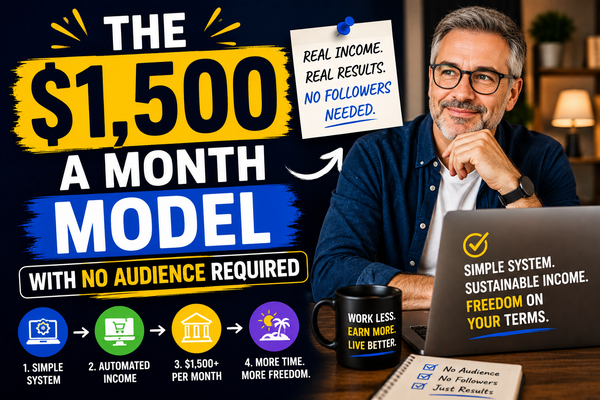
Not a second career. Not something that requires 40 hours a week or starting from scratch. Something that generates $1,000 to $2,000 a month using knowledge they already have — and that can keep running in retirement, on reduced hours, if they want it to.
Here's why that number matters more than it might seem.
If Social Security ends up delivering 80 percent of what's projected rather than 100 percent, a $2,800 monthly benefit becomes $2,240. That's a $560 monthly gap — real money, but a gap that a modest consulting income or knowledge-based side income closes completely.
If your savings are $150,000 short of where they should be, a $1,500 monthly income stream compensates for that shortfall for years.
In other words, a relatively small, sustainable income source doesn't just supplement your retirement. It insulates it. It gives you flexibility that no amount of worrying about Social Security policy can provide.
The shift I keep seeing among people who've figured this out is a move from passive to active. From "I hope the numbers work out" to "here's what I'm doing to make sure they do."
That shift doesn't require a dramatic life change. It requires a decision.
⚡ QUICK WIN
Find your real Social Security number in five minutes
Most people have only a vague sense of what their actual Social Security benefit will be. Here's how to get the real figure.
- Go to ssa.gov/myaccount and log in or create a free account — it takes about three minutes to set up.
- Navigate to "Your Social Security Statement" and open your earnings record.
- Find the estimated monthly benefit at age 62, 67, and 70 — these are your three claiming options, and the difference between them is significant.
- Write down the age-67 figure. That's your baseline for planning purposes.
- Compare it honestly to what you currently spend each month.
The gap between those two numbers is your planning target. It's useful, specific, and — once you have it — a lot less frightening than the vague dread most people carry around instead.
💡 OPPORTUNITY SPOTLIGHT
Why a small monthly income stream changes everything
One of the most underrated retirement planning moves isn't saving more. It's building something that earns.
Even a modest, consistent income stream — $1,000 to $1,500 a month — has an outsized effect on retirement security. It reduces the pressure on your savings to do all the work. It provides flexibility if Social Security ends up delivering less than projected. And it gives you something to scale back gradually rather than stopping cold.
The income models that work best for people in their late 40s and 50s are the ones that run on expertise, not effort. Knowledge consulting, advisory work, a simple newsletter, or a small online course — these aren't passive income in the get-rich-quick sense. But they're close to it once they're set up, and they can continue at reduced hours well into traditional retirement age.
The goal isn't to replace your retirement savings. It's to take the pressure off them.
A $1,200 monthly income stream, sustained for ten years into retirement, is the equivalent of having an extra $144,000 in savings — without saving a single additional dollar.
That's what makes this worth taking seriously now, while there's still runway to build it.
❝ READER STORY
Patricia, 56, spent 27 years in school administration — the last nine as an assistant superintendent in a mid-sized district in Ohio. Sharp, organised, and by her own admission, "not someone who worried much about money."
Until she logged into her Social Security account for the first time at 54 and did the math.
"My projected benefit was about $2,100 a month at 67," she told me. "My current mortgage payment alone is $1,400. I just sat there for a minute."
What Patricia did next was what separates the people who stay stuck from the ones who move forward. She didn't catastrophise. She got practical.
She spent about two weeks identifying what she actually knew how to do that someone might pay for. The answer, it turned out, was substantial: school district compliance, curriculum planning, administrator coaching, and board-level communications. Two decades of operational knowledge most smaller districts couldn't afford full-time.
She reached out to seven people in her network over the course of a month. Two conversations turned into a consulting arrangement with a rural district that needed part-time compliance support.
Eight months later she earns $1,800 a month from that arrangement, working about ten hours a week. She still has her full-time role.
"The Social Security number still isn't pretty," she said. "But it's not the whole picture anymore. I changed the picture."
That's the move. Not fixing Social Security — that's above our pay grade. Changing what the rest of the picture looks like.
CLOSING SIGN-OFF
The uncertainty around Social Security is real, and pretending otherwise wouldn't be honest. But uncertainty is only paralyzing if you're counting on something you can't control.
The people sleeping well at night aren't the ones who've solved Social Security. They're the ones who've stopped waiting for it to solve things for them.
Next issue, we're talking about the specific skills you've built over your career — and why they're worth considerably more on the open market than your salary ever reflected.
Until then,
Richard
P.S. If the Quick Win from this issue gave you a number that surprised you — in either direction — I'd genuinely like to hear about it. Hit reply. You'd be amazed how many people are sitting with the same figure.