What the data actually shows about AI and age
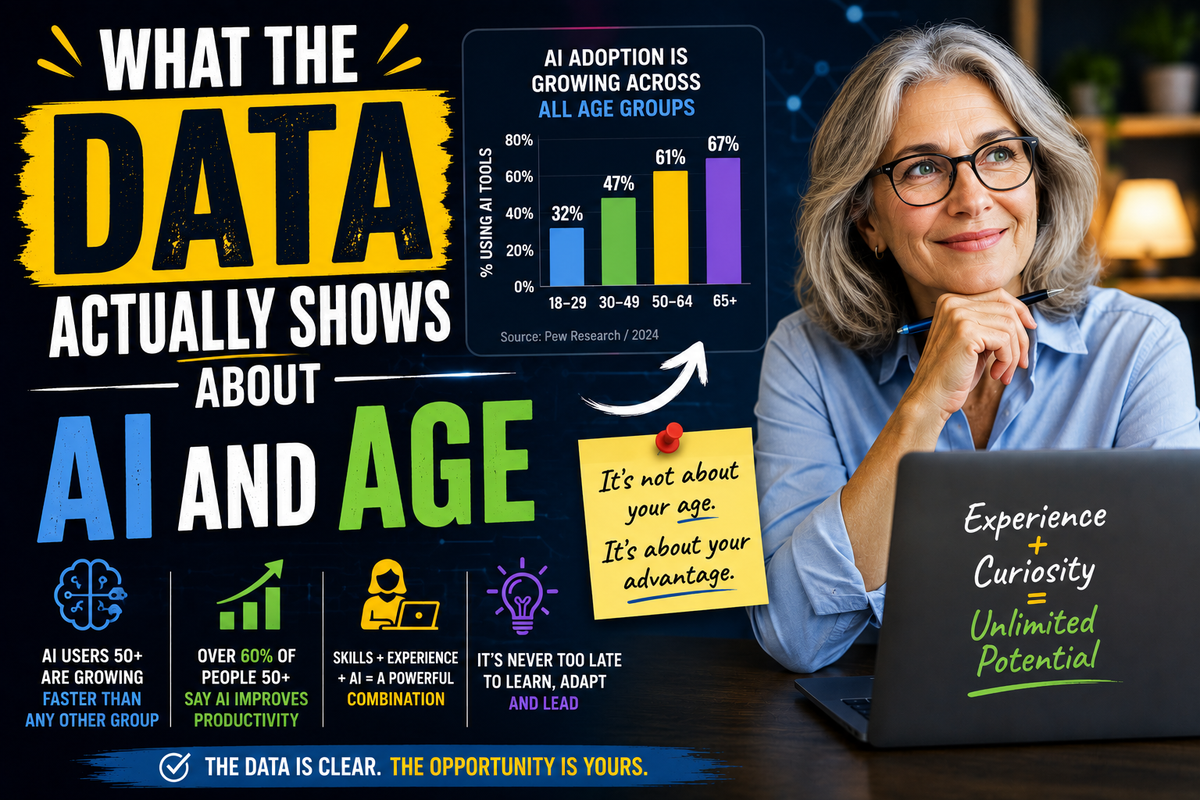
Here's Issue #10, ready to publish:
SUBJECT LINE OPTIONS
- AI isn't replacing experienced people
- What the data actually shows about AI and age
- The replacement story the headlines got wrong
PREVIEW TEXT
The narrative about AI and older workers is a lot more complicated than the headlines suggest. Here's what's actually happening.
OPENING HOOK
A reader named Tom sent me an email three weeks ago that I've been thinking about ever since.
He's 56, spent 28 years in financial services, and by his own description is "not particularly worried about much." But the AI headlines had gotten to him.
"Richard," he wrote, "every time I open a news app someone is telling me experienced professionals are about to be made obsolete. I'm trying not to panic. Help."
I wrote back to Tom. And what I told him is what I want to share with all of you today.
THIS WEEK AT A GLANCE
★ The Feature — What the research actually shows about AI, experienced workers, and who's most at risk — and most protected
⚡ Quick Win — A practical test to find out where AI helps you and where your edge is irreplaceable
💡 Opportunity Spotlight — How experienced professionals are using AI to earn more, not less
❝ Reader Story — How a 58-year-old financial analyst used AI to double his consulting output without working more hours
★ THE FEATURE
AI isn't replacing experienced people. Here's the proof.
Let's start with what's true.
AI is genuinely transforming how work gets done. Tasks that used to take hours — drafting documents, summarising information, researching a topic, formatting data — can now be done in minutes. That is real, and pretending otherwise wouldn't be honest.
Some jobs will change significantly. Some will disappear. The disruption is not invented.
But here's the part that gets left out of most headlines.
The jobs most at risk from AI are not the ones held by experienced professionals with decades of specialised knowledge. They're the ones built around high-volume, routine, rule-based tasks — data entry, basic research, templated writing, standardised customer service responses.
Those are, largely, entry-level and mid-level roles. The ones where output is the product and judgment is minimal.
The roles that AI cannot replicate — and the research is fairly clear on this — are the ones where judgment is the product. Where the value isn't in producing output but in knowing which output matters, why, and what to do when the situation doesn't fit the template.
Let me give you a specific example.
A junior analyst can use AI to produce a financial model faster than ever before. The AI can pull data, run calculations, generate charts, and format a report in a fraction of the time it used to take.
But the AI cannot tell you whether the assumptions behind the model are realistic. It cannot read the room in a client meeting and sense that the numbers, while technically correct, are going to land wrong. It cannot draw on 25 years of watching similar situations play out and say, quietly and confidently, "I've seen this before, and here's what actually happens next."
That's not AI's limitation. It's its nature. AI is pattern recognition at extraordinary scale. What it cannot do is apply genuine judgment to novel, high-stakes, human situations.
And genuine judgment — the kind that comes from decades of real experience — is exactly what experienced professionals have in abundance.
There's research that backs this up. MIT and Stanford economists studying AI's impact on the labour market have found something that doesn't make for dramatic headlines: AI tends to compress the gap between inexperienced and moderately experienced workers, while doing relatively little to reduce the advantage of the most experienced.
In plain terms: AI helps a two-year analyst get closer to a ten-year analyst. It does almost nothing to close the gap between a ten-year analyst and someone with thirty years of judgment and relationships.
In fact, the research suggests something more interesting. Experienced professionals who adopt AI tools tend to see the largest productivity gains of any group — not because AI does their job, but because it removes the low-level tasks that were consuming their time, freeing them to do more of the high-value work that only they can do.
Think about what that means in practice.
The consultant who used to spend three hours preparing a client briefing now spends forty-five minutes — and uses the remaining time to take on an additional client. The financial advisor who used to spend half her day on administrative tasks now spends that time on the relationship work that actually retains clients. The trainer who used to spend days building course materials now builds them in an afternoon, and spends the rest of the week delivering them.
AI isn't the threat the headlines suggest. For experienced professionals who engage with it thoughtfully, it's closer to the most useful productivity tool that's ever existed.
The risk isn't AI replacing you. The risk is staying away from AI while everyone around you uses it to do more in less time.
That's a meaningful distinction. And it's the one worth paying attention to.
⚡ QUICK WIN
Find your AI edge in under 20 minutes
This exercise has two parts — and the second part is the one that matters most.
- Open ChatGPT and give it a task you do regularly — drafting an email, summarising a document, outlining a plan, researching a topic. See how it does.
- Now think about the last genuinely difficult decision you made at work. Something where the answer wasn't obvious. Where you drew on experience, relationships, or pattern recognition that took years to develop. Write it down in a sentence.
- Ask yourself: could AI have made that call? Or even gotten close?
- The gap between what AI did well in step one and what it couldn't touch in step two — that gap is your professional moat. The thing that makes you irreplaceable.
- Now ask: am I currently charging what that moat is worth?
Most people find that step four is clarifying and step five is uncomfortable. Both reactions are useful.
💡 OPPORTUNITY SPOTLIGHT
How experienced professionals are using AI to earn more — not less
The most interesting pattern I've been watching over the past year isn't AI replacing experienced workers. It's experienced workers using AI to expand what they can offer — and charge accordingly.
A few examples of what this looks like in practice.
A former HR director uses AI to produce detailed compensation benchmarking reports for clients in a fraction of the time it used to take. She's taken on two additional clients as a result, without working additional hours.
A retired financial planner uses AI to build and stress-test financial models for his consulting clients — work that used to require a junior analyst he'd have to hire. He keeps the margin himself.
A curriculum consultant uses AI to draft instructional frameworks and then applies her expertise to refine and validate them. What used to be a two-week project now takes four days. She charges for the outcome, not the hours.
In each case, AI is handling the production. Experience is handling the judgment. And the combination is producing more output, more efficiently, than either could alone.
The income opportunity here isn't in AI itself. It's in using AI as leverage — to do more of the valuable work, with less of the time-consuming groundwork, at the same or higher rates.
For experienced professionals considering building a consulting practice or knowledge-based income stream, this is a genuine tailwind. The tools that used to require a team can now be handled solo. The overhead that used to make going independent feel risky has been dramatically reduced.
There has genuinely never been a better time to take what you know and build something with it.
❝ READER STORY
Robert, 58, spent 26 years as a financial analyst — the last decade specialising in risk assessment for mid-market commercial lending. When his bank was acquired and his division consolidated, he took a generous severance package and decided, at his wife's encouragement, to try consulting before looking for another job.
His concern about AI was specific and practical.
"I kept reading that AI was going to automate financial analysis," he told me. "I thought — if that's true, who's going to pay for what I do?"
He decided to test the assumption directly. He spent two weeks working alongside AI tools — using them for the parts of his work that were research and data-heavy, and observing carefully where the tools fell short.
What he found was instructive.
"AI could gather data faster than I ever could. It could format and present it clearly. But when I gave it a real-world lending scenario with ambiguous information and asked it to make a risk recommendation, it produced something technically coherent that any experienced lender would have immediately flagged as naive."
The AI didn't know what it didn't know. Robert did.
He built his consulting practice around exactly that distinction — offering risk assessment judgment, not risk assessment production. What he sold to clients wasn't a model or a report. It was 26 years of knowing what the model was missing.
Within eight months he had four clients on retainer arrangements, earning just over $3,800 a month for approximately fifteen hours of weekly work.
"AI made me more confident about consulting, not less," he told me. "It showed me exactly where my value was. And it wasn't where I thought it was going to be threatened."
CLOSING SIGN-OFF
The AI story is more nuanced than the headlines have time for. The short version is this: if your value is in producing things, AI is a challenge. If your value is in knowing things — the kind of knowing that only comes from decades of real experience — AI is a tool.
And tools, as any experienced professional knows, are only as useful as the person using them.
Next issue, we're getting specific about income models — the exact consulting structure that works best for people over 45, the numbers behind it, and how to build it without a sales background or a business degree.
Until then,
Richard
P.S. If you've been quietly worried about AI and what it means for your professional future — you're not alone, and Tom from the opening of this issue definitely isn't either. Hit reply. It's a conversation worth having.