What the data says about starting after 50
I want to tell you about a conversation I had with a woman named Ellen.
She was 54, recently laid off, and about forty minutes into what was supposed to be a practical conversation about consulting, she stopped mid-sentence and said something I've thought about many times since.
"Richard, I think I just left it too long."
She didn't mean the conversation. She meant everything. The pivot. The new direction. The idea of building something on her own terms at this point in her life.
I've heard some version of that sentence more times than I can count. And every time I do, I want to show the person saying it what I'm going to show you today.
THIS WEEK AT A GLANCE
★ The Feature — Where the "too late" belief comes from, why it's wrong, and what the data actually shows about starting after 50
⚡ Quick Win — A five-minute reframe that changes how you see your timeline
💡 Opportunity Spotlight — Why the 45+ window is actually one of the best times to build a knowledge-based income
❝ Reader Story — How a 57-year-old former marketing director proved herself wrong about being too late
★ THE FEATURE
You're not too late. Here's the data to prove it.
The "too late" belief is one of the most effective traps I know.
It feels like realism. It sounds like self-awareness. It even masquerades as humility — a kind of responsible acknowledgment that you're not 30 anymore and shouldn't pretend otherwise.
But it isn't any of those things. It's a story. And like most stories we tell ourselves, it's worth examining before we decide to live by it.
Let's start with some data.
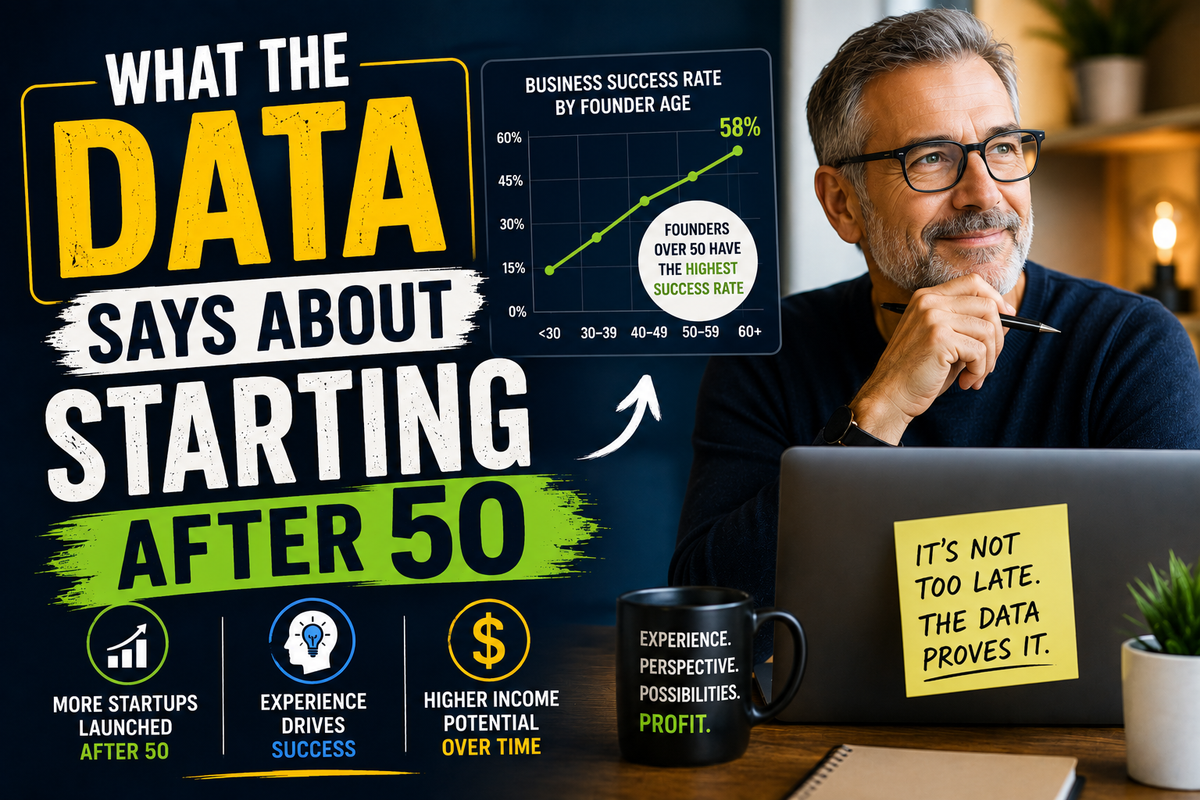
The Kauffman Foundation — one of the most respected research organisations tracking entrepreneurship in the United States — has found consistently that the average age of a successful startup founder is not 24. It's not even in the 30s.
The average age of founders whose companies achieved significant growth is around 45. And the highest success rates of any founding age group belong to people in their 50s.
Read that again, because it runs counter to everything Silicon Valley would have you believe.
People over 50 start businesses that succeed at higher rates than people under 30. Not slightly higher. Meaningfully higher.
Why? The reasons are the same ones we've been talking about throughout this newsletter. Better judgment. Stronger networks. Clearer understanding of what customers actually need versus what sounds good in a pitch deck. More realistic expectations. Less likelihood of making the expensive mistakes that come from inexperience.
The mythology of the young founder is exactly that — a mythology, built around a handful of famous exceptions and a lot of survivorship bias. For every Zuckerberg there are thousands of 23-year-olds who ran out of runway before they figured out what they were actually building.
The less glamorous but more reliable story is the one that plays out among experienced professionals who start something in their late 40s and 50s, built on two decades of real-world knowledge and a network that took years to develop.
That's your story. If you choose to write it.
Now let me address the version of "too late" that's more specific and harder to dismiss.
"I don't have enough time left to build something meaningful."
Here's the honest answer to that.
If you're 52 today, and you retire at 67, you have fifteen years. Fifteen years of compounding experience, compounding relationships, and compounding income — if you start building now.
If you spend the next two years getting started, making mistakes, and figuring out what works, you'll be 54 with thirteen years of a working, refined, income-generating practice ahead of you.
Compare that to the alternative: two more years of waiting, arriving at 54 with exactly the same situation but less time and no momentum.
The cost of waiting isn't neutral. Every year you delay starting is a year you don't have later. That's not meant to create urgency for urgency's sake. It's just true.
And here's the third version of "too late" I want to address, because it's the quietest one and often the most stubborn.
"Other people can do this. But probably not me specifically."
This one doesn't usually come out directly. It hides behind practical objections. I'm not tech-savvy enough. My network isn't strong enough. My industry is too niche. I'm not sure I'm actually an expert.
What it really is, underneath all of that, is fear wearing the mask of realism.
And the only answer to fear wearing that particular mask is evidence. Not reassurance — evidence. The kind that comes from taking one small step and seeing what happens.
Not a leap. A step.
Send one email to one person in your network this week about what you're thinking of doing. Have one honest conversation. Write down the one thing you know how to do better than most people you've worked with.
That's not building a business. That's just gathering evidence that the story you've been telling yourself might not be the whole truth.
Ellen, by the way — the woman from the opening — did eventually take that step. It took her another three weeks to stop arguing with herself about it. But she did.
Within six months she had two consulting clients and a waiting list for a third.
She told me recently: "I spent so long being afraid of being too late that I almost made it true."
Almost.
⚡ QUICK WIN
The five-minute timeline reframe
This isn't an exercise in positive thinking. It's an exercise in accurate thinking.
- Write down your current age and your intended retirement age. Calculate how many working years you have left.
- Now write: if I started building something today and it took two full years to get going properly, how many years would I have left to benefit from it?
- Write down one thing you've learned in the last ten years that you couldn't have known at 30. Just one.
- Ask yourself honestly: is the person who knows that thing too late to be useful to someone?
- Write down what you'd tell a close friend your age who said they thought they'd left it too long.
Read back what you wrote for number five.
That's usually the clearest thinking in the exercise. We're almost always more generous and accurate with friends than we are with ourselves.
💡 OPPORTUNITY Spotlight
Why your late 40s and 50s is actually the best window to build this
Most people assume the best time to start a knowledge-based income stream was ten years ago.
Here's why that's not actually true.
Ten years ago, you had less experience, a smaller network, and less clarity about what you were genuinely good at. You were also probably in the thick of building a career, raising kids, managing a mortgage, and carrying obligations that made risk feel genuinely dangerous.
Now, in many cases, the picture has shifted. The mortgage is smaller or gone. The kids are older or independent. The career is established enough that a side pursuit doesn't feel like gambling with everything.
And crucially — the market for knowledge-based income has never been more accessible. The tools to reach potential clients, communicate your expertise, and deliver value without leaving your home office simply didn't exist a decade ago the way they do now.
You're not arriving late to a party that's winding down. You're arriving at a moment when the infrastructure to do this has finally caught up with what experienced professionals actually have to offer.
The timing, it turns out, is better than it looks.
❝ READER STORY
Karen, 57, spent 26 years in marketing — the last decade as a brand director at a consumer goods company. When the company was restructured and her division was eliminated, she did what she describes as "six months of productive avoidance."
She updated her resume. She attended networking events. She told herself she was being strategic.
What she was actually doing, she admitted to me later, was postponing the moment when she'd have to decide what she actually wanted.
The "too late" belief showed up clearly at the six-month mark, when a younger colleague landed a CMO role she'd interviewed for.
"I told myself that was proof," she said. "That the market had moved on. That I was past it."
She almost convinced herself.
What stopped her was a conversation with a former client — a small consumer brand whose founder had worked with Karen years earlier and still talked about her as the best brand strategist he'd ever encountered.
He asked if she'd be open to a consulting arrangement. She said yes, mostly out of curiosity.
That first engagement paid her $2,200 a month for about eight hours of work. The founder referred her to two other brands in his network within three months.
By the time Karen and I spoke, she had four clients, a waiting list, and a monthly income that exceeded her previous salary.
"The thing that gets me," she said, "is that I almost didn't do it. I almost let a story I'd made up in my own head become true by default."
She paused.
"That would have been the actual waste."
CLOSING SIGN-OFF
The "too late" belief is seductive because it lets you off the hook. You don't have to try something uncomfortable. You don't have to risk being wrong. You get to stay safe inside a story that excuses inaction.
The only problem is the life you don't get to live while you're in there.
Next issue, we're back to the practical side of things — a real story about how one experienced professional turned 30 years of classroom knowledge into a thriving online income, and exactly what the path looked like.
Until then,
Richard
P.S. If you've had your own version of the "too late" moment — and found your way through it — I'd love to hear about it. And if you're in the middle of one right now, hit reply. Sometimes just saying it out loud to someone who gets it is the first step.